A New Blue
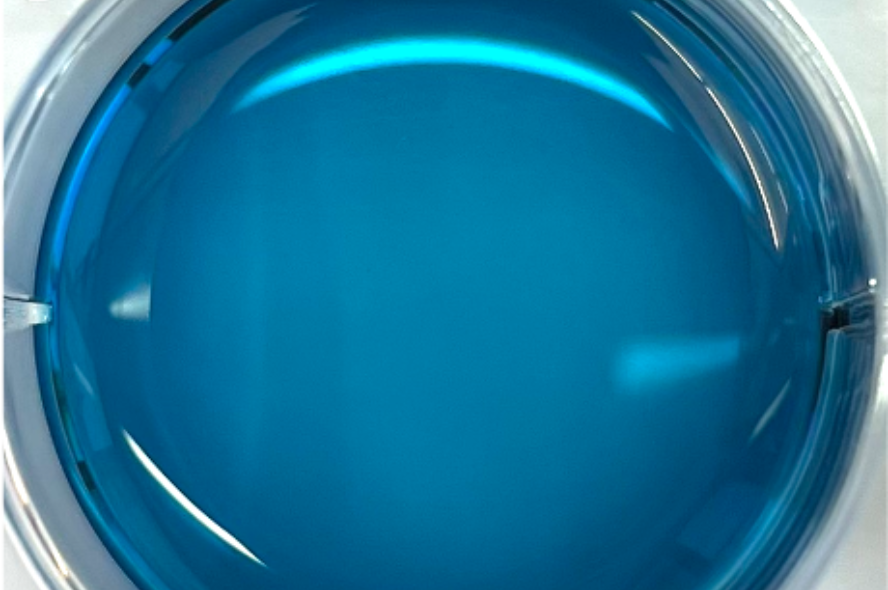
Blue is one of nature’s rarest hues. Unlike other colors, which come from pigments like melanin, blue is believed to be the result of structural color, where microscopically structured surfaces reflect light in certain ways that appear blue.
“If you Google, is a bluebird really blue? Google will tell you, no, a bluebird is not blue, because it's ‘blue’ is based on reflection,” said Di Sheng Lee, a postdoctoral scholar in Stern Family Distinguished Professor David Kaplan’s lab. This understanding of structural color extends to most blue things in nature, like the sky, blue eyes, or blue markings on animals.
But what was previously understood to be a trick of the light may be pigmentary color after all, according to new research from the Tufts Center for Cellular Agriculture.
In pigment-based colors, the length of the chromophore determines the color of the melanin. Shorter chains produce colors on the shorter end of the visible light wavelength—like red, orange, or yellow—while longer chains produce brown or black shades. It has been widely accepted that blue melanin does not occur naturally, since it would require a long chain of amino acids with enough homogeneity that it doesn’t turn brown or black.
Lee, Kaplan, and fellow researchers in the Department of Biomedical Engineering and Tufts Center for Cellular Agriculture recently took on the challenge of creating blue melanin using principles from protein design and advances in machine learning. Their successful creation of blue melanin was published in Protein Science.
How to Create a Color
To create a pigment-based blue, the researchers precisely engineered a long strip of tyrosine, which is the amino acid that produces melanin. Melanin is not a protein, but is created from a chain of amino acids which are the building blocks of proteins. The longer the strip becomes, the more likely it is to become heterogeneous and turn brown. The researchers hypothesized that two key properties would be important for creating blue melanin: tight packing during peptide assembly and high solubility in aqueous environments.
Using a deep learning method known as RFdiffusion, they narrowed down 160,000 possible combinations of amino acids to ten options that had their desired properties. Of these, one produced blue melanin.
Potential Benefits in Industry and Biology
Blue melanin holds promise for industrial applications such as food dyes, cosmetics, textiles, and paint. “Since these are peptide-based solutions, the pigments should be human and environmentally compatible,” the authors write. Blue melanin may be especially useful for blue food dye, which is hard to replicate naturally. Currently, blue-green algae known as spirulina is a leading option for natural blue food dye, but it degrades at high temperatures. In contrast, the Tufts researchers tested their blue melanin for stability and found that it could survive temperatures of 121 degrees Celsius and did not photodegrade after weeks of light exposure.
Their research also suggests that blue melanin may occur naturally in animals.
Animal biologists use a strong alkaline substance to extract melanin for study, but blue melanin degrades into brown melanin at a high pH. “Now using AI, we can prove the existence of blue melanin from the bottom up, so that's one way to tell that it may actually occur naturally too,” said Lee. If biologists used different extraction techniques that do not rely on alkaline substances, Lee hypothesizes that it might be possible to find naturally occurring blue melanin in birds and other animals.
The possibility makes sense from a biological standpoint. Since the blue melanin polymer is so long, it’s energetically costly to create. “If an animal could make blue melanin, that would mean it’s in a very good, healthy state, and is able to use a lot of energy to make this blue pigment, so it's a good signal of biological fitness,” explained Lee. This aligns with the fact that blue is a common signaling method in mating. “There’s a lot of small evidence everywhere, and with this work the puzzle is starting to come together,” Lee said.
The Future of Blue
Further research is needed before blue melanin can be produced on a larger scale, but their work is a promising first step toward synthetic blue that could be used in a wide variety of scenarios. Moving forward, Lee and fellow researchers hope to create a melanized protein, the next evolution of the melanized peptide they created. They also plan to do nuclear magnetic resonance on blue melanin to better understand its structure. “We are trying to engineer bacteria to express blue melanin based on the microbial fermentation technique, so we can make it more cheaply and scale it up for industrial production,” Lee shared.
Lee also hopes that biologists will use his findings to seek evidence of blue melanin in animals. Although it’s still just a hypothesis for now, their work indicates the possibility of pigmentary blue melanin in nature. “Maybe, James Cameron is right about the blue Avatar,” Lee joked.
Department:
Biomedical Engineering